WINES: A Nose for Trouble

My First Taste of a Top Wine Blind Tasting
I had always imagined that my first invitation to a top wine blind tasting would be a sophisticated affair: mahogany tables, low lighting, well-dressed gentlemen discussing terroir, and glasses that looked as though they might shatter if you breathed on them too enthusiastically. I pictured myself swirling with effortless elegance, detecting blackcurrant, tobacco and cedar, and casually identifying a legendary Bordeaux while everyone nodded in respectful admiration.
Reality, as I was soon to discover, has a wicked sense of humour.
My preparation consisted of reading a few wine books, memorizing a handful of grape varieties, and sniffing my kitchen cupboards. Cinnamon, cloves and vanilla were straightforward. Wet stone was harder; I had yet to find a convincing way of smelling a stone without looking like a man who needed professional help.
The invitation arrived on a Thursday. A respected wine merchant was hosting an advanced blind tasting of distinguished wines from Bordeaux, Burgundy, the Rhône and perhaps a few surprises beyond. The guests would be collectors, sommeliers, merchants and serious enthusiasts, people who debated vineyards with the intensity normally reserved for constitutional crises.
And then there was me, with a dangerous habit of believing every expensive bottle must taste better than a cheap one. Naturally, I accepted immediately.
The Theatre of the Glass
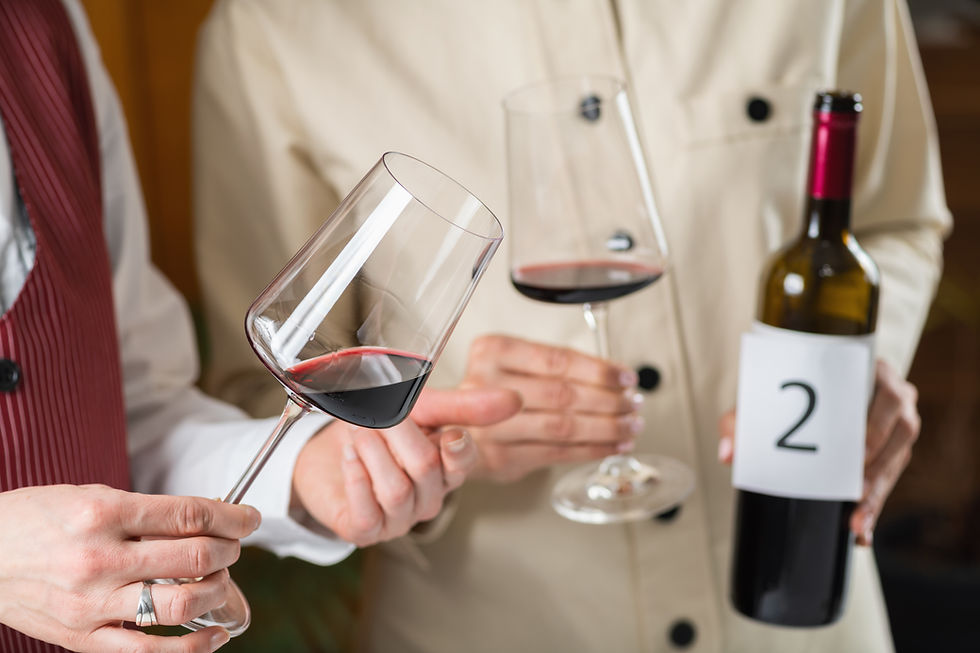
The tasting took place in an elegant private room above the merchant's showroom shop premises. Rows of immaculate tulip-shaped glasses stood beside numbered cards, and several bottles lurked beneath dark sleeves. I heard the words Grand Cru several times before I had taken off my jacket, and I suddenly became very conscious of my shoes.
At the entrance, a gentleman whose knowledge of wine appeared to extend back to the Roman Empire asked whether I had done many blind tastings.
"A few," I replied, with the measured vagueness of a politician asked about an inconvenient expense.
In truth, my previous blind tastings had involved covering labels at dinner parties and trying to tell a £12 wine from a £15 one. Once, I had confidently identified a Spanish red as a Chilean Cabernet Sauvignon, only to discover that both bottles came from the same supermarket promotion. I decided not to mention this.
Around me, one man explained how the growing season had shaped a region's tannins, while another wondered whether a wine's structure suggested whole-bunch fermentation. I nodded appreciatively, still trying to remember whether tannins made your mouth dry or made red wine red. (The former. Colour comes from pigments in the skins. I would learn this, like much else that evening, immediately after demonstrating I didn't know it.)
The Rules of the Game
Blind tasting is a little like identifying a stranger in a dark room using nothing but their shoes, accent and general attitude. You examine the colour, assess the nose, then taste, weighing sweetness, acidity, tannin, alcohol, body and finish, before making an educated guess about grape, region, vintage and, if you are feeling reckless, producer.
The trick is to distinguish observation from interpretation. "High acidity, firm tannins, blackcurrant fruit and restrained oak" is a description. "Unquestionably a 2010 Pauillac from a classified growth" is a hostage situation involving your reputation.
Wine Number One: The Confidence Trap
The first glass was deep ruby with a slight garnet rim. The nose offered blackcurrant, cedar, pencil shavings and tobacco, with a savoury layer beneath the fruit. The acidity was fresh, the tannins firm but polished, and the finish impressively long. It had the poise of a wine that knew exactly how much it cost and had no intention of apologizing.
I wrote: Bordeaux, probably Pauillac or Saint-Julien, with a little bottle age. I felt rather pleased with myself.
It turned out to be a Cabernet-dominated red from a different region altogether.
I stared at the glass, then at my notes, then back at the glass. The wine had not changed. My confidence had simply been removed from the room. The host explained that cassis, cedar and structure can resemble Bordeaux, but that the fruit profile and balance pointed elsewhere. I crossed out my guess with a determination that suggested the paper had personally offended me.
The lesson was that blind tasting is about weighing evidence, not recognizing one aroma and declaring victory. Unfortunately, this did not stop me making the same mistake twenty minutes later.
Burgundy and the Art of Being Wrong Elegantly
The second red was translucent ruby, with red cherries, raspberries, dried rose petals, then forest floor and a hint of mushroom. Pinot Noir, I thought, and this time I felt confident. I briefly considered Oregon and New Zealand, then briefly considered that I was overthinking everything. I settled on Burgundy.
The reveal was not the Burgundy I had imagined. My grape was correct, but my geography had once again exceeded the evidence. Recognizing a grape is one skill; naming its origin is another; naming a vineyard or vintage is another again. The more specific the guess, the greater the risk. It is rather like identifying a dog as a spaniel, then insisting it is a particular spaniel from a particular village because it has an aristocratic expression.
My Vocabulary Problem
Wine can be muscular, elegant, austere, plush, restrained or brooding. I wondered whether the industry had recruited literary critics and encouraged them to spend too much time in cellars. The problem arises when description replaces analysis. I once heard a taster describe a wine as having "the emotional architecture of a forgotten summer." It was a beautiful phrase, but I remained unsure whether the wine was good.
I resolved to keep my notes practical. For a white in the third flight, I wrote: lemon zest, green apple, pronounced acidity, moderate body, restrained oak. Then, almost as an afterthought: "Could be Chardonnay."
It was an elegant cool-climate example. For about four seconds I felt the satisfaction of solving a difficult crossword. Then the host asked for the region, and I was wrong. Naturally. Even so, it was my first genuine success, reasoned from acidity, fruit and body rather than from the buttery, heavily oaked style that dominated my early understanding of the grape.
The Most Dangerous Aroma in Wine
Then came a red with an earthy, slightly medicinal character. The gentleman beside me announced with great authority that it showed a classic note of Brettanomyces. Brett is a yeast that can contribute leather, spice, smoke or stable-like aromas; a subtle trace appeals to some tasters, while excess overwhelms the fruit and becomes a fault. I knew this in theory. But I could not confidently find it in the glass, so I wrote: "Savoury, earthy, possibly medicinal."
It was the wisest note of the evening, because it described what I could actually perceive without pretending my nose held specialist credentials. Afterwards, experienced tasters disagreed about whether the character was a stylistic feature or a flaw. Expertise does not eliminate subjectivity.
When the host announced a flight of mature wines, the room changed. People sat straighter. Conversation quietened. Old wine carries a particular mystique: decades of careful storage, favourable weather, skilled winemaking, sheer luck, and an uncomfortable amount of anxiety about the cork.
The first mature red was garnet-brown at the rim, with dried cherry and plum, leather, cedar, tobacco and forest floor. The tannins had softened. The finish was long but not forceful. For once I forgot to ask whether it was expensive or famous. I simply wanted to keep smelling it.
I guessed traditional Bordeaux with several decades of age, and the reveal confirmed the broad direction. I was absurdly pleased. Then the host mentioned the bottle's market value, and I briefly wondered whether financial guilt could be experienced through the nose. But the wine's real value was a demonstration of what time can do to a wine suited to ageing and properly stored. Of course, the price tag did help concentrate the mind.
The Bottle That Defeated Everyone
No blind tasting is complete without a wine that leaves the room arguing. The final flight's dark, savoury red, with black fruit, pepper, smoke and a meaty impression, divided opinion. Some tasters detected the northern Rhône, others a southern interpretation, a few a New World Syrah, and one particularly confident guest an entirely different grape.
Syrah was my first thought. Then I became suspicious of my own confidence, and tried to separate what identified the variety from what reflected winemaking choices. It was the first time that evening I felt I was approaching the problem methodically. I wrote down Syrah, possibly Rhône, and marked it tentative.
The wine came from a region I had considered but not confidently chosen. I had not been entirely right, but neither had I been wildly wrong, and I could explain my reasoning. In blind tasting, a thoughtful near miss is more informative than a lucky correct answer.
What I Learned
By the end, my notebook resembled the record of a small intellectual disaster, with "fresh acidity" written so often it had lost all meaning. Yet I had learned more in a few hours than in weeks of reading.
I learned to slow down. I learned to separate what I smelled from what I thought the wine might be: "blackcurrant, cedar and firm tannins" is evidence, while "definitely a famous Bordeaux" is a hypothesis, and confusing the two is an excellent way to become confidently incorrect. I learned that acidity, tannin and body matter as much as fruit. And I learned that price is no shortcut to pleasure. Some of the evening's best bottles appealed through freshness, balance and drinkability rather than prestige.
The best tasters were also the least intimidating. They asked questions, acknowledged uncertainty, and wanted to know why someone else had reached a different conclusion. There were, admittedly, moments of theatrical certainty. One gentleman delivered his conclusions with the authority of a Supreme Court judge, though I privately suspected his nose might benefit from a more independent judiciary.
My Beginning, Not the End
Appreciating wine is not about performing expertise; it is about paying attention. You do not need to name the vineyard to enjoy a beautiful Pinot Noir, and you certainly do not need to describe a wine as having "a haunting mineral tension" if all you mean is that it tastes crisp and leaves you wanting another sip.
My first blind tasting had not made me a master sommelier. It had, however, made me a more attentive drinker, and taught me an essential truth: confidence is a useful companion at a wine tasting, but humility is the better vintage.
I have not abandoned my ambition to announce the correct region, grape and vintage to a room of astonished experts. One day, perhaps. Until then, I shall keep tasting, learning and occasionally confusing one prestigious region with another. I shall also keep sniffing the occasional kitchen cupboard, though I have finally stopped trying to smell wet stones.
And if my next blind tasting begins with a wine that smells unmistakably of blackcurrant, cedar and expensive mistakes, I shall take a thoughtful sip, write down what I actually taste, and resist the temptation to declare victory.
At least until the bottles are revealed.
Then, naturally, I shall nod as though I knew all along.


