FEATURES: The Story Behind Britain’s Beloved Pub Chain

Anyone who has ever been into an English pub or lives in England will surely have heard of the pub brand Wetherspoon, fondly referred to as Spoons. They took the UK by storm with their innovative approach to an English way of life that is centuries old.
I love old British pubs; the culture, the warmth, the vibrancy, and the community vibe. So on a warm summer's day recently, the U.K has been experiencing a heat wave, so I went in search of a Wetherspoon’s in Lewisham, South East London.
I settled into a quiet corner on a midweek afternoon, a pint of Murphy’s in hand, and found myself thinking about how this whole empire began. It started in December 1979 when a young Tim Martin, freshly qualified as a barrister but with no real interest in practicing law, took over a former bookmakers on Colney Hatch Lane in Muswell Hill. He called it Martin’s Free House at first. A few weeks later it became Wetherspoon, named after a mild-mannered New Zealand teacher who couldn’t control his class, and the “JD” pinched from Boss Hogg in The Dukes of Hazzard. Martin later admitted he felt just as out of his depth running that first pub.
What followed was a quiet revolution in British pubs. Inspired by George Orwell’s 1946 essay The Moon Under Water”, the ideal of a quiet, Victorian-style pub with good beer, decent food and no loud music, Martin built a chain that prized value, real ale and accessibility. He converted banks, theatres, cinemas and car showrooms instead of fighting the big brewers for traditional pubs. By 1992 the company had floated on the stock market. The rest is the sprawling, carpeted, slightly chaotic landscape we know today: hundreds of pubs, dozens of hotels, and a reputation that still divides opinion.
Sitting here now, that history feels present in the glass and on the plate.
The Beers: The Real Heart of the Story
The beer range is still the strongest thread connecting today’s Wetherspoons’ to Martin’s original idea. Most pubs keep a reliable core of permanent real ales on the handpumps; Greene King IPA, Abbot Ale, Doom Bar and the like, alongside a rotating cast of guest ales. You can usually find three or more cask beers at any time, and the quality is remarkably consistent for a chain this size.
They’ve been Cask Marque accredited for years and take temperature and condition seriously.
The seasonal and festival offering is where it gets genuinely interesting. Twice a year the chain runs big real-ale festivals featuring around thirty different beers, including several from overseas.
There are also regional and Scottish-focused festivals, plus occasional cider events. During festival periods you can get three third-of-a-pint tasters for the price of a pint; a simple, generous way to explore without committing.
Outside those periods, there are still quarterly seasonal guest ales available to request, plus a growing craft selection (BrewDog Punk IPA, various hazy IPAs, and regional craft cans and draught). Prices remain one of the chain’s quiet superpowers. A decent pint of real ale or craft is still noticeably cheaper than most high-street pubs. Many cost around just £2-4 a pint, almost half the price of most surrounding pubs. The app, displayed on every table, makes it easy to check what’s on, set alerts, and order your food and drinks directly to your table. Murphy’s at £3.10 per pint (for those that don’t know, it’s very similar to Guinness, and is often more popular in southern Ireland). The value for money factor is what makes these pubs so popular.
Each individual pub retains its own name (I think it might be a licensing thing) but is solely owned, managed and operated as a Wetherspoon’s house. The one in Lewisham is named The Watch House.
For a national chain, the beer offering still feels curated rather than token. It is the clearest living link to Martin’s early belief that good, affordable real ale should be available to everyone.
The menu and the food
The food side of the story is more complicated. The menu is vast: breakfast until late morning, then burgers, pub classics, curries, steaks, pizzas, chicken dishes, salads, jackets, small plates and a steadily improving plant-based section. The famous club deals: Curry Club on Thursdays, Steak Club, Fish Friday, still deliver some of the best-value proper meals you can get in a British pub.
Portions are generally generous. When the kitchen is on form, the battered fish and chips is a solid, honest plate: crispy batter, a proper piece of sustainable cod or haddock, and a big pile of chips. The better burgers (especially those with pulled brisket or Korean-style chicken) are satisfying and better than they need to be at the price. Thursday curries remain reliable crowd-pleasers. Steaks are properly cooked if you specify how you want them. Breakfast is another quiet strength; a full or large English will set you up without emptying your wallet.
The honest truth, though, is that quality varies almost as much as the choice of the beers. Chips can be excellent one visit and a bit soggy the next. Some of the more ambitious or “gourmet” items can taste a little industrial or reheated when the pub is slammed. Service speed depends heavily on how busy the place is and how many staff are working. I’ve had excellent, hot, well-presented meals and the occasional lukewarm disappointment. It has never pretended to be fine dining. You are paying for volume, consistency of offering, and value rather than culinary fireworks. Desserts do the job if you have room; sticky toffee pudding or a brownie with ice cream, but they rarely linger in the memory.
My overall feeling
What stays with me is the continuity. The same man who couldn’t control his first little free house in 1979 still shapes a chain that, for all its quirks and criticisms, has made decent beer and affordable food available on an extraordinary scale. The unusual buildings, the local history displays, the carpets, the quiet (or at least quieter) atmosphere in most pubs, all of it still echoes that early Orwell-inspired vision.
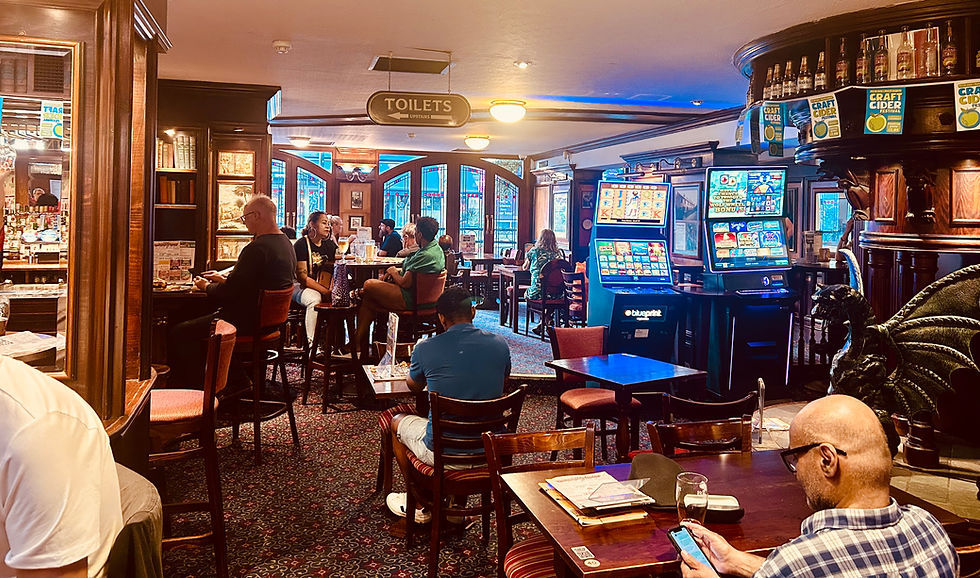
The pubs cater to the local community and give regulars plenty of reasons to come back time and time again. As well as the cheap food and ales, they have the popular slot machines, and there’s always a TV around showing the latest news.
I finished my pint of Murphy’s and ordered another while watching the room fill up with students, pensioners, families, solo drinkers, people killing time before a train. Wetherspoons’ is not for everyone, and it never claims to be. But for what it is, a democratic, value-driven, real-ale-focused British pub chain with a surprisingly rich origin story, it still delivers more often than it disappoints. I left knowing I’ll be back.